
Starting with social media marketing services? Understand what happens in the first 90 days, including strategy, content creation, campaigns, and KPIs.
Most brands sign a contract with a social media agency expecting a spike in followers by the second week.
That expectation is exactly what causes 90% of client-agency breakups before the contract is even complete. Now, what you, as a business, need to understand here is that this is not a content problem; it’s a timeline problem.
If you know what to expect from social media marketing services before you sign, you stop mistaking ‘building the engine’ for ‘the engine not working.’ Here’s what actually happens across the first 90 days, broken down by what should be delivered, when, and how to tell if you’re on track.
The 90-Day Timeline at a Glance
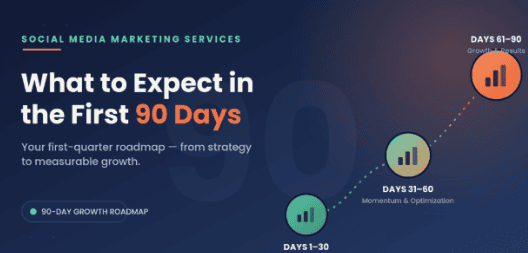
Before we get into what’s happening week by week, it helps to see the whole arc in one place. The table below breaks the 90 days into 3 clear phases, so you know exactly what’s being worked on and what you can expect at the end of each stage.
| Phase | Timeframe | Primary Focus | What You Should See |
| Foundation | Days 1–30 | Audit, strategy, account setup | Written strategy doc, competitor audit, content calendar draft |
| Execution | Days 31–60 | Content production and publishing | Consistent posting, first engagement data and creative testing |
| Optimization | Days 61–90 | Data-driven refinement | Performance report, adjusted content mix, 90-day roadmap |
This is the standard shape of social media marketing services, whether you’re hiring a freelancer, a boutique shop, or a full-service agency. The pace changes with budget and scope, but the sequence doesn’t. The sections below cover all the details related to each phase.
Days 1–30: Foundation, Not Followers
The first month is administrative by design, and that’s the part most businesses underestimate. A social media team can’t post intelligently until it understands your audience, your competitors, and your brand voice well enough to sound like you without sounding generic.
What should actually happen:
- Access handover – Platform logins, brand assets, past creative, and any existing analytics get transferred over. Delays here push the entire 90-day clock back.
- Competitor and audience audit – Not a vanity report. A real audit identifies which competitors are winning engagement, on what content types, and why your current presence isn’t.
- Content pillars and calendar – You should receive a documented plan covering content themes, platform priorities, and posting cadence, not a vague promise of “engaging content.”
- KPI baseline – Current follower count, engagement rate, and reach get recorded so month three’s numbers mean something.
If you’re 30 days in and haven’t seen a written strategy document, that’s the clearest early warning sign that the engagement is off track.
Days 31–60: Execution and the First Real Signals
This is where content actually starts publishing on a consistent schedule, and where most clients start asking, “Why aren’t we trending yet?” The best social media marketers prefer working on organic social rewards consistently over weeks, not virality over days.
During this phase, expect:
- Regular publishing across the agreed platforms, following the content calendar from month one
- Early engagement data, including comments, shares, saves, and click-throughs, is directional, not conclusive
- Format testing across reels vs. carousels vs. static posts, to see what your specific audience actually responds to
- First round of creative revisions based on what’s landing and what isn’t
A useful gut check here: compare week 8 metrics to week 4, not to your competitor’s account that’s been active for three years. Growth rate matters more than absolute numbers this early.
Days 61–90: Optimization and the First Real Report
By day 90, a competent digital marketing team gathers enough data to stop the guesswork and start optimizing the actual content. This phase is where marketing services should shift from let’s see what works to here’s what’s working, and here’s why we’re doing more of it.
You should walk away from day 90 with:
- A performance report comparing month three against the baseline set in month one
- A clear read on which content pillars, formats, and platforms are earning engagement
- An adjusted content mix based on actual data, not assumptions
- A roadmap for months four through six, including whether paid social should be layered in
If your hired marketing agency can’t answer what changed since day one and what’s planned next, that’s a bigger red flag at 90 days than a slow follower count.
What NOT to Expect in 90 Days
Most social media marketers focus their pitch on what they will deliver and forget to mention what they will not. Knowing the limits of a 90-day window is just as important as knowing the milestones. So, here’s a quick list of things you cannot expect in the first 90 days of your social media campaign-
- Viral growth – Organic reach on every major platform has been throttled for years; consistent, incremental growth is the realistic outcome, not overnight virality.
- Lead volume that rivals paid ads – Paid social generates leads in weeks. Organic social builds trust and audience first, and pipeline attribution usually shows up well after day 90.
- A finished brand voice – Voice and content pillars keep getting refined through month six as more audience data comes in.
- Follower count is the main metric – Engagement rate, saves, and click-throughs predict long-term traction far better than raw follower growth.
Setting this expectation upfront, ideally before the contract is signed, is what separates agencies that keep clients past month four from ones that don’t.
How to Tell If Your 90 Days Are on Track
A quick way to sanity-check progress without needing to be a social media expert yourself:
| Check | Good Sign | Warning Sign |
| Strategy document | Delivered by day 30, specific to your brand | Vague, generic, or missing entirely |
| Communication | Weekly updates, proactive flagging of issues | Radio silence between reports |
| Metrics tracked | Engagement rate, saves, click-throughs | Only the follower count is discussed |
| Day 90 report | Data-backed, includes a plan for months 4–6 | A recap with no forward plan |
Knowing what to expect from social media marketing services in advance turns this checklist into a conversation you can have with your agency at week two, not a dispute you have at month four.
Conclusion
Judge the first 90 days by the wrong yardstick, and you’ll cancel a strategy right before it starts paying off. The real output of this window isn’t followers or virality; it’s a tested content system: pillars that work, formats your audience actually engages with, and a data trail that makes month four smarter than month one.
That system is what compounds. Brands that measure the first quarter on process and directional data, not vanity metrics, are consistently the ones still seeing growth at month twelve. The ones that don’t are usually the ones restarting from scratch with a new agency every 90 days.
FAQs
- How soon will I see results from social media marketing services?
Ans. Early engagement signals typically show up within the first 60 days, but meaningful follower growth, lead volume, or brand recall usually needs 4–6 months of consistent execution to compound.
- What should I expect from social media marketing services in month one specifically?
Ans. Expect an audit, a documented content strategy, KPI baselines, and account setup — not published content yet. Month one is foundation-building, not output.
- Is it normal for follower growth to be slow in the first 90 days?
Ans. Yes. Organic platforms reward consistency over time, not speed. Engagement rate and content quality are better early indicators than raw follower count.
- What red flags suggest a social media agency isn’t performing?
Ans. No written strategy by day 30, vague reporting with no specific metrics, and a day-90 review with no plan for months four through six are the clearest warning signs.
- Should I add paid social if organic results feel slow after 90 days?
Ans. Often, yes. Paid and organic work on different timelines, paid can accelerate reach and lead volume while the organic strategy keeps compounding in the background.
