
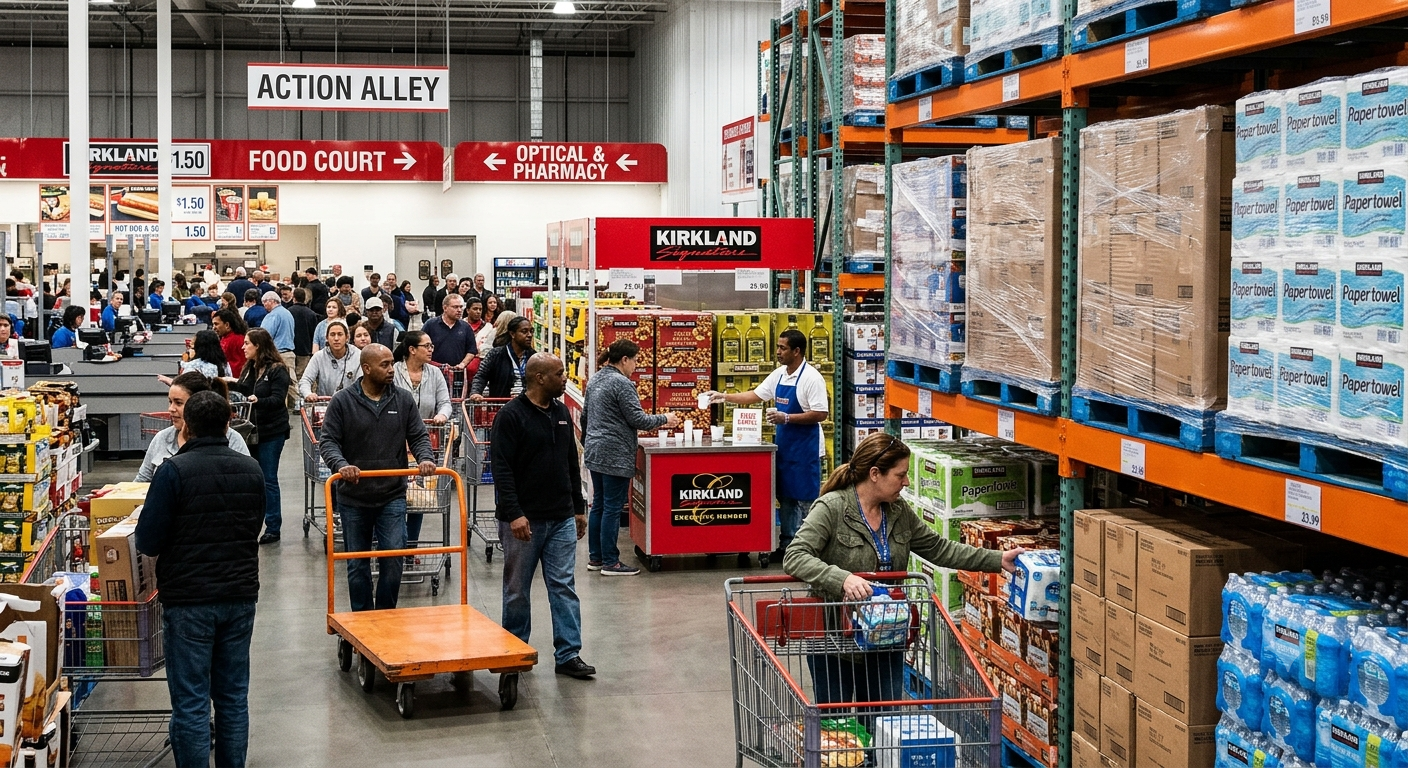
Walking into a warehouse can feel like entering a retail amusement park designed for smart shoppers. What started as a converted airplane hangar in San Diego has transformed into a global powerhouse reshaping how we think about purchasing goods. The Costco model proves that consumers will happily pay an annual subscription fee simply for the privilege of spending more money under its roof.
It is a business architecture built on razor-thin margins, extreme bulk packaging, and high asset turnover. While traditional retailers try to maximize margins per item, this wholesale pioneer prioritizes high-volume throughput and absolute member retention. The result is a corporate entity that functions less like a conventional grocery store and more like an elite buying club for over 147 million cardholders worldwide.
Understanding how Costco balances price, quality, and member experience reveals a masterclass in human psychology and operational efficiency. Let’s pull back the heavy industrial curtain to examine what makes this company an unstoppable force in modern commerce.
The Economics Behind the Warehouse Model
To understand why Costco can offer drastically lower prices than traditional supermarkets, you have to look past the giant pallets of paper towels and focus on the balance sheet. The entire financial framework rests on a simple, counterintuitive concept: selling goods almost at cost and making the majority of its profit from membership fees.
Traditional grocery chains routinely mark up products by 25% to 50%. In stark contrast, this wholesale leader caps its markup on name-brand goods at around 14%, and approximately 15% for its private label. The revenue collected from Gold Star and Executive memberships provides a predictable, upfront cash flow stream. This reliable capital buffer allows the company to absorb market volatility and aggressively negotiate with suppliers.
+-------------------------------------------------------------+
|                     COSTCO PROFIT ENGINE                    |
+-------------------------------------------------------------+
|                                                             |
|   [ Membership Fees ]  ===========>  Provides 75-80% of     |
|                                      Operating Income       |
|                                                             |
|   [ Product Markups ]  ===========>  Kept ultra-low (~14%)  |
|                                      to cover overhead      |
|                                                             |
+-------------------------------------------------------------+
High inventory turnover is another crucial element of the brand’s operational DNA. Stock doesn’t sit gathering dust on shelves; it moves out of the warehouse in days, often before the company has even paid the vendor for the inventory. By keeping total stock-keeping units (SKUs) remarkably low—around 4,000 items compared to a typical supermarket’s 30,000 or a supercenter’s 100,000—the brand commands unprecedented purchasing leverage. When they buy an item, they purchase it by the container load, forcing manufacturers to lower prices to secure a coveted spot on the warehouse floor.
Decoding the Costco Floor Plan: The Treasure Hunt Design
Nothing about a trip to Costco is accidental. The industrial layout is intentionally engineered to manipulate consumer behavior, prolong shopping times, and drive unplanned impulse purchases through a strategy known internally as the Treasure Hunt.
The Deceptive Entrance and the Action Alley
When you walk past the card scanners, you are immediately greeted by high-ticket electronics, seasonal displays, and jewelry. This area is designed to establish a benchmark of luxury and value, putting you in a purchasing frame of mind. As you move deeper into the building, you hit “Action Alley”—the wide central racetrack of the warehouse where high-demand items are piled high on pallets.
Why You Can’t Find Signs or Mirrors
Have you ever noticed the complete lack of aisle signs detailing exactly where the soup or cereal is located? This is a deliberate tactic to ensure shoppers wander. The company frequently relocates staple items, forcing you to scan multiple shelves and look at hundreds of other products before locating your target. By removing mirrors from the apparel section and putting the most essential goods—like milk, eggs, and fresh meat—at the very back corner of the store, the warehouse maximizes your exposure to temptation.
The Power of Food Samples
The small paper cups filled with sizzling sausage or bite-sized pizzas do far more than offer a free snack. Product sampling plays into the deep-seated human psychology of reciprocity. When a friendly demonstrator hands you a free sample, you experience a subtle, subconscious urge to repay the kindness by purchasing the full box. Furthermore, the stations physically slow down foot traffic, breaking your focused shopping momentum and encouraging lingering looks at adjacent aisles.
The Genius of Kirkland Signature
A massive pillar of the Costco identity is its proprietary house brand, Kirkland Signature. Introduced in 1995 as a way to unify dozens of disparate private-label names, the brand represents a master stroke in consumer trust and supply chain management.
+-----------------------------------------------------------------+
|                    THE KIRKLAND PRIVACY PARADOX                 |
+-----------------------------------------------------------------+
|  While packaged in Kirkland Signature branding, many items are  |
|  secretly produced by elite premium manufacturers:             |
|                                                                 |
|  * Kirkland Coffee      ---> Custom roasted by Starbucks        |
|  * Kirkland Batteries   ---> Manufactured by Duracell           |
|  * Kirkland Tuna        ---> Sourced via Bumble Bee             |
+-----------------------------------------------------------------+
The underlying corporate directive for Kirkland Signature is simple: it must be equal to or better in quality than leading national brands, while retailing for at least a 20% discount. To achieve this, the company partners with premium manufacturers to package elite products under the house label.
Consumers have come to realize that buying the house brand does not mean compromising on quality. Whether it is premium extra virgin olive oil, multi-ply toilet paper, or high-end golf balls. The brand commands fierce consumer loyalty. This proprietary umbrella acts as an effective bargaining chip against major consumer packaged goods corporations. If a national brand refuses to lower its wholesale prices. The warehouse can simply give preferential shelf space to its own Kirkland equivalent.
Ancillary Services: Driving Value Beyond the Aisles
The value proposition extends well beyond the boundaries of standard grocery and household shopping. The warehouse ecosystem is, meticulously designed to be a one-stop shop for every facet of a member’s lifestyle, creating an incredibly sticky ecosystem.
- The Gas Stations: Strategically positioned near the exit lanes, these high-volume fueling stations offer top-tier gasoline at steep discounts. The low gas prices function as a powerful loss leader, drawing drivers to the location week after week.
- Optical and Pharmacy Centers: By offering cut-rate prescription medications, designer frames, and contact lenses, the brand integrates itself directly into the health and wellness routines of its members.
- The Food Court: The $1.50 hot dog and soda combo is a legendary retail fixture. This pricing has remained completely unchanged since 1985, serving as a powerful symbolic promise of value to every consumer walking out the door.
- Costco Travel: Members can book deeply discounted vacation packages, cruises, and rental cars, utilizing the brand’s immense corporate buying leverage to slash vacation costs.
Corporate Culture and Employee Retention
In an industry notorious for high turnover rates, low wages, and precarious scheduling, the corporate culture of Costco stands out as a radical anomaly. The organization operates under a firm belief that treating employees exceptionally well directly translates into superior business performance and member satisfaction.
The average hourly wage for warehouse workers sits significantly higher than the standard retail industry average. Additionally, the vast majority of employees qualify for comprehensive health insurance, 401(k) matching, and paid time off. This generous compensation model is not charity; it is a calculated business strategy that yields immense dividends.
Because employees feel valued and secure, the company enjoys incredibly low turnover rates. The institutional knowledge retained by long-term staff creates a highly efficient workplace environment where logistics run smoothly, checkout lines move fast, and shrinkage due to internal theft remains practically nonexistent. Happy employees create a welcoming atmosphere, cementing the premium feel of the buying club.
Navigating the Membership Structure
To unlock the savings hidden within the warehouse aisles, consumers must select a tier from the structured membership platform. Deciding which level fits your household budget requires an evaluation of your annual spending habits.
| Membership Tier | Annual Fee | Key Features & Incentives | Best Suited For |
| Gold Star | $65/year | • Access to all global locations • Two household cards included • Full money-back guarantee | Individuals, small households, and occasional shoppers. |
| Executive | $130/year | • 2% Annual Cash Back Reward • Extra discounts on auto & travel services • Premium customer service perks | Families, heavy shoppers, and small business owners. |
The math behind upgrading to an Executive membership is straightforward. The additional fee over a basic membership is $65. Because the Executive tier awards a 2% annual cash-back reward on qualifying warehouse purchases, spending roughly $3,250 a year ($270 per month) allows the membership upgrade to completely pay for itself. If your annual household spending exceeds that threshold, the Executive tier effectively puts money back into your pocket.
Pro-Tips for Maximizing Your Savings
Walking into a warehouse without a plan can quickly result in a $400 receipt for items you didn’t know you needed. To truly win the game, seasoned shoppers rely on a collection of insider strategies.
Crack the Price Tag Code
The numbers on the edge of a shelf tag contain hidden information regarding markdowns and inventory status.
- Prices ending in .99: Standard, full-price merchandise.
- Prices ending in .97: A local manager markdown intended to clear out stale stock quickly. These represent major deals.
- Prices ending in .00 or .88: Typically indicates a returned, open-box, or last-remaining item that the manager has priced to move immediately.
- The Asterisk (*): A small star in the upper right-hand corner of a price tag means the item is discontinued and will not be restocked. If it is a favorite product, buy it now.
Utilize the Generous Return Policy
The organization boasts one of the most consumer-friendly return policies in the history of retail. Members can return almost any item at any time for a full refund if they are unsatisfied with its performance. While electronics carry a strict 90-day return window, most other items—including half-eaten food products or years-old household goods—can be brought back to the returns desk without issue, providing total peace of mind.
Conclusion
The enduring success of Costco lies in its relentless, unyielding commitment to value. It has successfully created an environment where consumers confidently hand over money every single year just for the right to shop. By combining smart psychological layout strategies, the high-quality assurance of Kirkland Signature, and an unparalleled operational model, the warehouse giant has made bulk buying a foundational component of modern culture.
If you are looking to maximize your household budget, take a closer look at your shopping habits. Audit your monthly spending, decipher the pricing codes on your next warehouse run, and evaluate if upgrading your membership tier makes financial sense. Armed with the right strategies, you can transform your routine warehouse trips into an optimized masterclass in personal finance.
Frequently Asked Questions
1. Can you shop at Costco without a membership?
Yes, there are a few legal workarounds to access the warehouse without an active annual card. The most seamless method is using a Costco Shop Card (a proprietary gift card), which can only be purchased or reloaded by an active member but can be spent by anyone. Additionally, non-members can utilize the indoor pharmacy for prescription medications, purchase alcohol in certain U.S. states due to local laws, or place orders online via delivery services like Instacart, though online prices carry a premium markup.
2. Why does the cashier check your receipt at the exit door?
The inventory control specialists stationed at the exit doors are not looking for shoplifters, nor are they tracking your honesty. Their primary operational directive is to verify that the cash register operators scanned your basket accurately. They look for double charges on bulk items, ensure that promotional discounts were applied correctly, and verify that high-ticket electronics items were properly handled at the front lanes, protecting both your wallet and the company’s inventory accuracy.
3. How does the 2% Executive Reward program work?
Executive members accumulate a 2% reward on most qualifying purchases made inside the warehouse or online via the e-commerce site. Approximately two months before your annual membership renewal date, the company mails out an official Reward Certificate. This certificate functions exactly like cash within the building and can be, applied toward your checkout total or cashed out entirely at the customer service desk. Certain purchases, such as gasoline, alcohol, and tobacco products, are excluded from earning the reward based on regional regulations.
4. Is everything sold in bulk actually cheaper than standard grocery stores?
While the price per unit or price per ounce is generally significantly lower at the warehouse, bulk shopping is not universally cheaper for every single product. Staple commodities like milk, eggs, rotisserie chickens, and cheese are almost always loss leaders that beat standard supermarket prices. However, name-brand sodas, cereal boxes, or specialty beauty items can occasionally be, found at lower prices during local supermarket promotional sales cycles or when utilizing manufacturer coupons.
5. Why are there no bags provided at the checkout registers?
In a relentless effort to eliminate operational waste, reduce checkout times, and keep corporate overhead exceptionally low, plastic or paper shopping bags are never offered at checkout. Instead, the company reuse the heavy corrugated cardboard shipping boxes that products are originally packed in. Cashiers will neatly pack your bulk goods into these open-top boxes, minimizing environmental waste and accelerating the speed of the front checkout lanes.
