
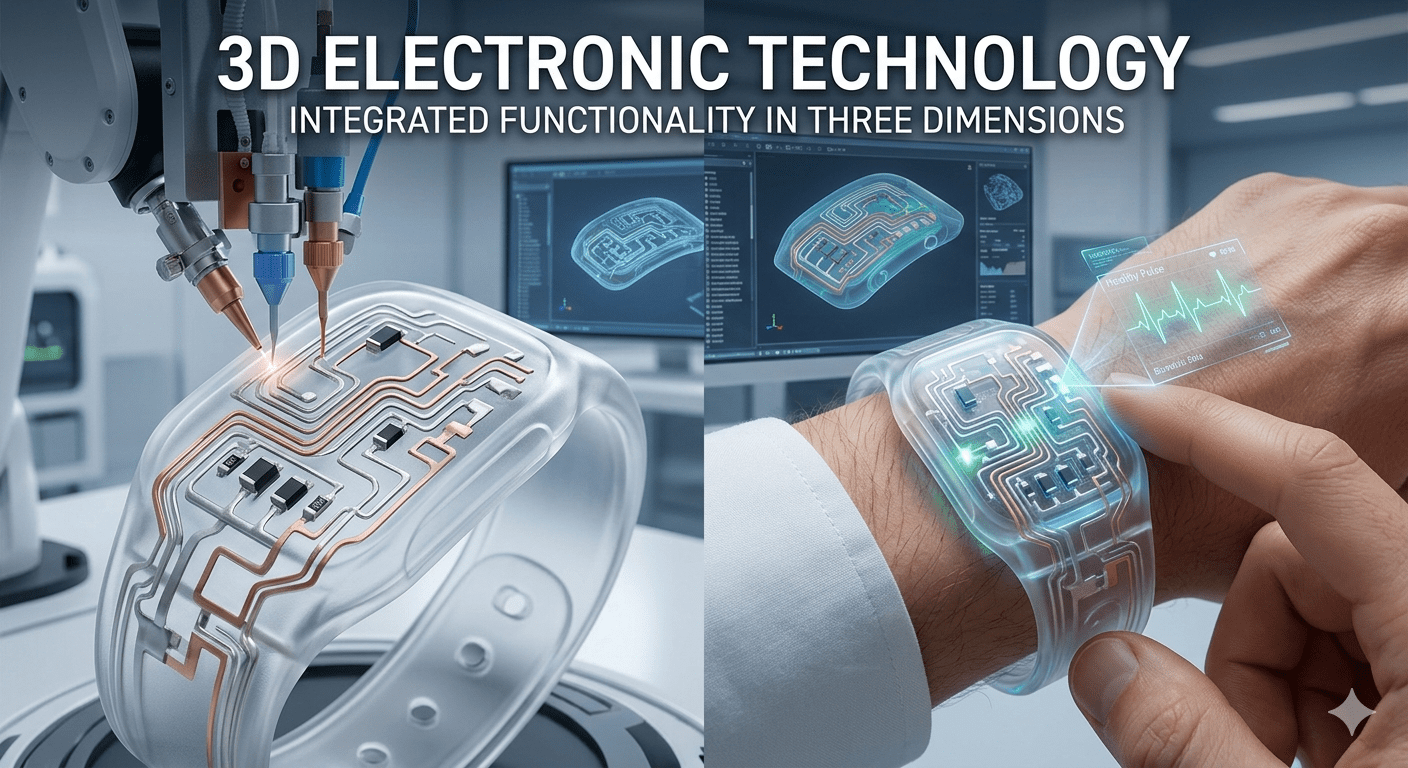
For decades, the world of electronics has been bound to a flat land. We have packed billions of transistors onto sheet-like silicon wafers and wired components together on rigid, two-dimensional printed circuit boards (PCBs). But the physical world isn’t flat. As our devices shrink and our demands for smarter, more integrated technology grow, traditional manufacturing is hitting a wall.
Enter the era of the 3D electronic ecosystem. By integrating circuit functionality directly into three-dimensional structures, this groundbreaking approach is reshaping how we design, manufacture, and interact with technology. From life-saving medical implants to structural sensors in aircraft, 3D electronics are turning everyday surfaces into intelligent components.
What Exactly is a 3D Electronic System?
To appreciate this shift, we have to look past the standard green circuit boards found inside your computer. A traditional PCB acts like a canvas where components sit on top of a flat surface. In contrast, a 3D electronic system embeds conductive tracks, components, and sensors directly into or onto the three-dimensional body of an object.
This can be achieved through various methods, such as printing conductive inks onto molded plastic parts or using advanced additive manufacturing (3D printing) to build the structure and the circuitry simultaneously.
The Core Technologies Behind 3D Electronics
Several manufacturing methodologies have emerged to bring these complex structures to life:
- Molded Interconnect Devices (MIDs): This process typically uses injection-molded plastic parts that are subsequently laser-etched and plated with conductive metals to create circuit paths.
- In-Mold Electronics (IME): Circuitry is printed onto a flat plastic film, which is then thermoformed and injection-molded into a final 3D shape.
- Direct-Write and 3D Printing: Aerosol jet printing or extrusion-based 3D printing dispenses conductive inks directly onto complex, non-planar surfaces.
Why the Move Toward 3D Electronic Design?
The transition from 2D to 3D circuit architectures isn’t just a design trend; it is a technological necessity driven by the limitations of space and physics.
1. Radical Space Savings and Weight Reduction
By eliminating the need for bulky PCBs and heavy wiring harnesses, 3D electronic design allows engineers to utilize previously wasted space inside a device. Circuitry can follow the contours of a product’s housing, reducing the overall footprint and weight of the system.
2. Enhanced Design Freedom
Designers are no longer constrained by square or rectangular enclosures. An earpiece, a steering wheel, or a drone wing can now house its own intelligence seamlessly. The structural component is the electronic component.
3. Improved Reliability and Performance
Traditional electronics rely heavily on solder joints, connectors, and cables, which are often the primary points of mechanical failure. By embedding circuits within a solid structural matrix, 3D electronic assemblies offer superior resistance to vibration, shock, and environmental moisture.
Key Industries Adopting 3D Electronic Solutions
The versatility of this technology means it is finding a home in virtually every sector that relies on hardware innovation.
+------------------+---------------------------------------------------------+
| Industry         | Primary Use Case                                        |
+------------------+---------------------------------------------------------+
| Automotive       | Smart dashboards, touch-sensitive trim, integrated keys |
| Aerospace        | Structural health sensors, lightweight wire replacement  |
| Medical Devices  | Custom hearing aids, smart prosthetics, wearable patches|
| Consumer Tech    | Ergonomic wearables, compact IoT sensors, smart home dev|
+------------------+---------------------------------------------------------+
Automotive and Aerospace
In modern vehicles, weight equals fuel consumption or battery drain. Automotive manufacturers use 3D electronic techniques to create sleek, touch-sensitive center consoles without the bulky mechanical switches hidden underneath. In aerospace, embedding sensors directly into a carbon-fiber wing allows for real-time structural health monitoring without adding aerodynamic drag.
Healthcare and Wearables
Human bodies are full of curves and organic shapes. Medical devices that interface with patients benefit immensely from 3D electronic personalization. From hearing aids customized to the exact shape of a patient’s ear canal to flexible patches that monitor vital signs, the technology bridges the gap between rigid silicon and soft biology.
The Materials Powering the 3D Electronic Evolution
Building a reliable 3D electronic device requires a delicate harmony between structural substrates and functional materials. You cannot simply use standard copper and fiberglass when printing on a curved, flexible surface.
Conductive Inks and Pastes
The lifeblood of printed electronics lies in specialized inks. These inks are often loaded with silver, gold, or copper nanoparticles. They must possess low viscosity to be printed smoothly, yet maintain high conductivity and flexibility once cured.
Substrate Materials
The base structures can range from high-performance polymers like PEEK and polycarbonate to flexible elastomers and biocompatible silicone. The main challenge is ensuring the conductive ink adheres perfectly to the substrate, even when subjected to thermal expansion or mechanical bending.
Challenges Facing the 3D Electronic Market
While the potential is vast, widespread adoption still faces several engineering and economic hurdles.
Standardizing Design Software
Most Electronic Design Automation (EDA) software was built for the flat world. Designing a 3D electronic component requires merging electrical CAD with mechanical CAD (MCAD). While software companies are bridging this gap, the workflow can still be fragmented and complex for engineers.
Speed of Production
Traditional high-speed surface-mount technology (SMT) lines can churn out thousands of flat PCBs per hour. Additive 3D electronic manufacturing, particularly when using precise dispensing or inkjet methods, is inherently slower. As a result, it is currently optimized for high-value, customized, or low-to-medium volume production.
Inspection and Repair
When a circuit path is buried deep inside a 3D printed polymer structure, you cannot simply fix it with a soldering iron. Non-destructive testing methods, such as X-ray computed tomography or advanced optical inspection, are required to detect internal defects.
The Future of 3D Electronic Innovation
We are only scratching the surface of what is possible. As material science advances, we will see the emergence of truly multi-functional materials—substances that can act as structure, conductor, battery storage, and sensor all at once.
Furthermore, the integration of sustainability into 3D electronic manufacturing is gaining traction. Researchers are developing biodegradable substrates and recyclable conductive inks, paving the way for eco-friendly devices that leave a minimal carbon footprint when their lifecycles end.
Conclusion: Embodying the Third Dimension
The shift toward 3D electronic architecture represents a fundamental rewrite of the rules of hardware engineering. By dissolving the boundary between mechanical housing and electrical circuitry, this technology unlocks unprecedented form factors, slashes device weight, and elevates structural durability.
While manufacturing throughput and standardized design tools remain areas of active development, the momentum is undeniable. The future of innovation isn’t flat—it is multi-dimensional, deeply integrated, and thoroughly structural.
Frequently Asked Questions (FAQs)
1. How does a 3D electronic circuit differ from a standard 3D printed object?
A standard 3D printed object only creates a static, mechanical shape out of plastic, resin, or metal. A 3D electronic device combines mechanical printing with the deposition of functional materials (like conductive inks or embedded sensors), creating an active, intelligent object capable of routing power and signals.
2. Can 3D electronics handle high-power applications?
Currently, most 3D electronic applications are optimized for low-power signals, data transmission, and sensing. Because printed conductive inks have higher electrical resistance than solid copper traces on a traditional PCB, high-power applications can suffer from excessive heat generation. However, ongoing material advancements are steadily improving current-carrying capacities.
3. What role does In-Mold Electronics (IME) play in this field?
IME is a subset of the 3D electronic ecosystem. It involves printing flat circuitry onto a film, which is then shaped (thermoformed) and injected with plastic resin. This is highly efficient for high-volume manufacturing, making it incredibly popular for creating seamless touch interfaces in automotive interiors and smart appliances.
4. Are 3D electronic components more expensive to manufacture?
For mass-produced, simple devices, traditional flat PCBs remain more cost-effective due to economies of scale. However, for complex geometries, highly customized medical devices, or low-volume aerospace components, 3D electronic manufacturing can reduce overall costs by eliminating assembly steps, wires, connectors, and manual labor.
5. How are these devices recycled at the end of their lifespan?
Recycling presents a unique challenge because the conductive metals are often, tightly bound to or embedded within the plastic substrates. However, current research is, heavily focused on developing “triggerable” materials that allow the plastics and precious metals to separate easily when exposed to specific chemical baths or thermal treatments, making future 3D electronic devices highly sustainable.
