
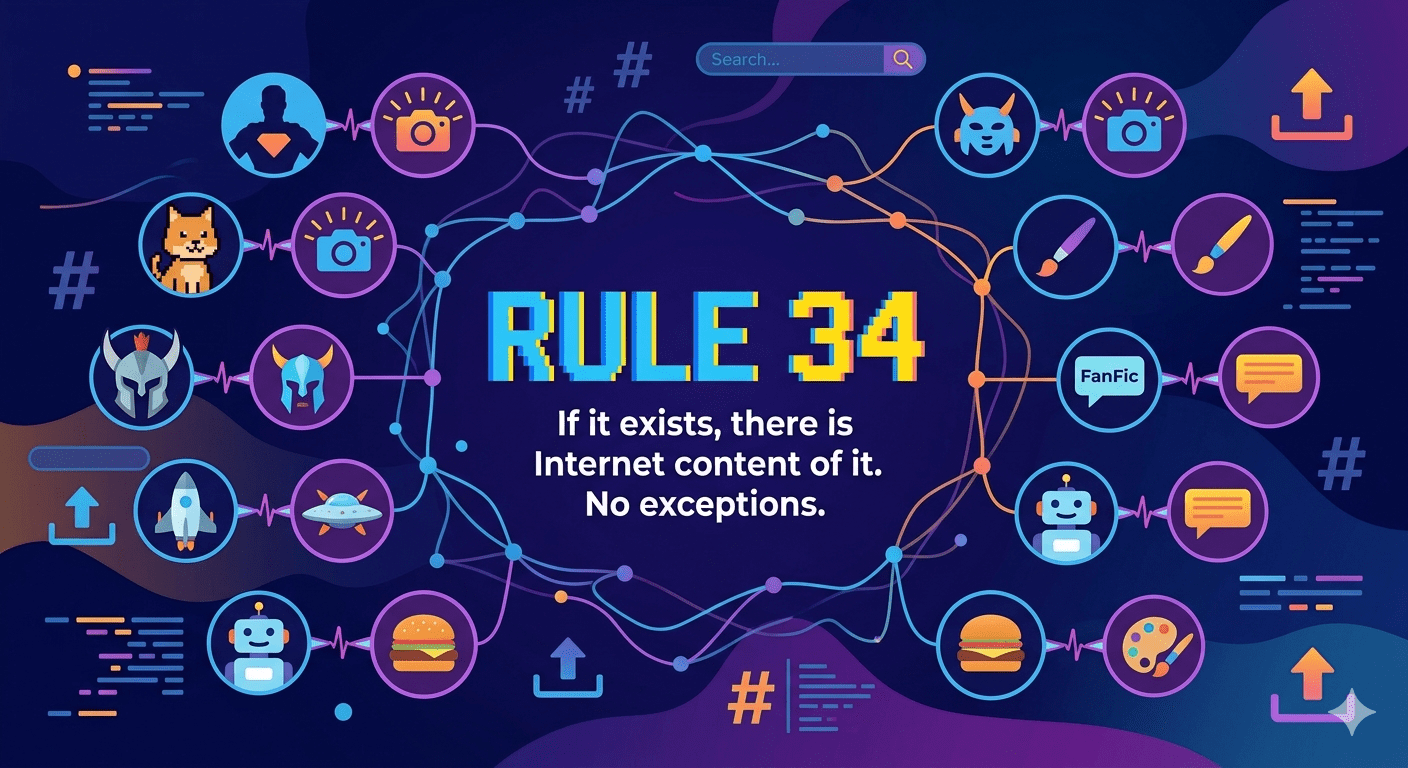
The internet is governed by an unwritten, ever-evolving set of laws created by its early communities. Among these informal maxims, none has achieved more notoriety or widespread recognition than Rule34. This simple concept states that if something exists in reality or fiction, an adult-oriented, explicit version of it can be found somewhere online. What started as a niche joke on an imageboard in the early 2000s has transformed into a massive pillar of digital culture, shaping how content creators, fandoms, and casual internet users interact with media.
To understand the modern landscape of fan culture and online communities, one must examine the mechanics behind Rule 34. It is no longer just a meme; it is a lens through which we can view human psychology, copyright law, and the absolute inevitability of user-generated content in the digital age.
The Origins of an Internet Axiom
The birth of Rule 34 traces back to a webcomic created in 2003 by Peter Morley-Souter. In the comic, he expressed shock at discovering explicit fan art of the classic UK children’s television show Thunderbirds. The comic featured a caption declaring it “Rule #34” of the internet.
The concept truly exploded when it migrated to early imageboards like 4chan. These anonymous forums codified a broader list known as “The Rules of the Internet.” While many of those original rules faded into obscurity, Rule34 resonated universally due to its undeniable accuracy in predicting online content trends.
The framework was eventually completed by its sister axiom, Rule 35. This rule acts as a fallback plan, stating: “If no such content exists, it will be made.” Together, these two concepts highlight the relentless, proactive nature of digital content creators.
The Psychology: Why Does Everything Get Adapted?
At first glance, the sheer volume of explicit material generated under the banner of Rule 34 might seem bizarre. However, psychologist and media theorists point to several deeply ingrained human behaviors that drive this phenomenon.
Subversion of Innocence
Taking wholesome, nostalgic childhood characters and placing them in adult scenarios is a powerful form of psychological subversion. It allows individuals to bridge the gap between their childhood memories and adult desires.
Parochial Fandom and Ownership
Modern media consumers do not just passively watch television or play games; they interact with them. Transforming characters through fan art is the ultimate expression of taking ownership over a piece of media, pushing past the boundaries set by original creators.
Taboo and Curiosity
The human brain is, naturally drawn to novelty and forbidden concepts. The anonymous nature of the internet provides a safe space for users to explore niche interests, obscure pairings, and bizarre crossovers without the fear of social judgment.
Fandoms, Copyright, and the Legal Gray Zone
The explosion of Rule34 content has created an incredibly complex legal minefield for major media corporations. Technically, unauthorized adult art featuring copyrighted characters constitutes copyright infringement and trademark violation. Yet, the actual legal response from companies varies wildly depending on corporate culture.
+-------------------+--------------------+------------------------+
| Corporate Strategy| Approach           | Example Industry       |
+-------------------+--------------------+------------------------+
| Aggressive Takedown| Heavy DMCA Notices | Nintendo, Disney       |
| Passive Acceptance| Ignoring Fan Art   | Indie Game Developers  |
| Tactical Embrace  | Acknowledging Buzz | Western Animation      |
+-------------------+--------------------+------------------------+
Many companies opt for a hands-off approach because targeting fan communities often triggers severe public relations backlash. Additionally, explicit fan art keeping a franchise relevant in online discussions acts as a form of free, albeit unconventional, marketing.
Technical Drivers: How the Internet Automates Rule34
The sheer speed at which new pop culture properties receive the Rule 34 treatment is a testament to the infrastructure of the modern web. It is no longer a slow, manual pipeline of independent artists working in isolation.
- Dedicated Aggregators: Massive open-source imageboards utilize sophisticated tagging systems, allowing users to find specific characters or concepts within seconds of a media release.
- Algorithmic Hype Engines: Social media algorithms reward high-engagement, shocking, or visually striking content, pushing explicit fan adaptations to the top of feeds.
- AI Art Generation: The introduction of advanced machine learning models has supercharged production. Generative AI allows users to create high-quality, customized imagery instantly using text prompts.
Because of these automated and algorithmic systems, the time gap between a character being revealed in a movie trailer and the creation of explicit fan art has shrunk from days to mere minutes.
Cultural Legacy and Mainstream Integration
While Rule 34 originated in the deepest, most anonymous corners of the web, it has gradually bled into mainstream pop culture. Television shows, video game developers, and mainstream celebrities frequently reference the rule, signaling their awareness of how internet culture operates.
Fandoms for games like Overwatch, Pokemon, and League of Legends possess massive sub-communities entirely dedicated to this type of content. Rather than destroying these franchises, the constant stream of user-generated content has arguably extended their lifespans, maintaining highly active fanbases long after official updates slow down.
Ultimately, the rule serves as a monument to human creativity and internet democracy. It proves that once a piece of art is released into the world, the audience—not the creator—decides how it will be remembered, remixed, and reimagined.
Conclusion
The legacy of Rule34 is a reflection of the internet itself: chaotic, boundary-pushing, infinitely creative, and entirely unstoppable. What began as a hyperbolic joke about a 1960s puppet show has accurately predicted the behavior of digital networks for over two decades. It proves that human curiosity and the desire to. Create will always outpace corporate control, algorithmic filters, and traditional social taboos. As long as new stories are told and new characters are designed. The internet will continue to fulfill its most famous unwritten law.
Frequently Asked Questions
1. What exactly does Rule 34 mean?
It is an internet maxim stating that if a concept, character, or media property exists in real life or fiction, an explicit, adult-oriented version of it has been created online.
2. Where did the term originate?
The phrase was coined in a 2003 webcomic by Peter Morley-Souter. It later gained widespread traction and was codified on anonymous imageboards like 4chan as part of the informal “Rules of the Internet.”
3. Is Rule 34 content illegal?
In most cases involving fictional characters, it falls into a legal gray area under copyright law. While it technically violates intellectual property rights, most corporations do not pursue lawsuits due to the difficulty of policing anonymous creators and the potential for fan backlash.
4. What is Rule 35?
Rule 35 is the direct companion to the main rule. It states that if no adult content of a specific subject can be found yet, it is an absolute certainty that someone will create it in the future.
5. How has AI changed this phenomenon?
Generative artificial intelligence has radically accelerated the creation process. Instead of relying entirely on skilled artists, anyone can now use text-to-image AI tools to generate highly specific explicit content instantly, removing traditional barriers to entry.
